 |
El Payaso - M. A Cruz (2006) (Score and Parts)
Intermediate 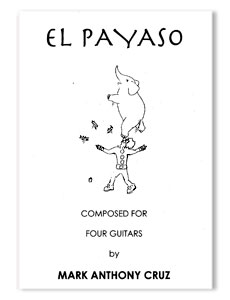
A work composed in a Spanish/Classical style. This is a programmatic
piece in E major exhibiting strong thematic material influenced
by Torroba, Bach, and Jenkins. It is also the 1st prize composition
of the Austin Classical Guitar Society sponsored 2006
Guitars Galore composition competition. .
EL PAYASO HIS GREAT CIRCUS ACT
Introducing the world’s greatest clown, El Payaso! - who
accomplishes amazing feats in two incredible acts for thousands
around the world.
El Payaso knows that a successful performance begins with his
brilliant capacity to stall his two main events for the purpose
of inebriating his audience with anticipation. So he warms them
up withtalents of slapstick and dancing, intertwining his physical
comedy with graceful movements of leaping and twirling.
Dazzled by his abilities, the audience watches with great expectations
for his first colossal feature. To their amazement, an enormous
canon is wheeled into the ring pointing upward at an 80 degree
angle and yet, there is no net in sight. Only El Payaso is brave
enough to attempt such a feat, for he intends to defy gravity
at the height of his ascent with only the assistance of an umbrella
that will help ease his way gracefully back to earth.The spectators
observe his finale with speechless tongues and minds in disbelief.
El Payaso juggles three flaming knives while balancing an elephant
on his nose. His observers would be even more amazed at all
of these accomplishments if only they knew that he achieves
all this while intoxicated.
EL PAYASO PROGRAM NOTES
Within the eight bar introduction, this programatic work
establiinterpolating hints of “Barnum and Bailey’s
Favorite” by Karl L. King . shes a circus theme by The
main theme is then presented and serves as a leitmotif to depict
El Payaso in obeisance, acknowledging the reception of his audience,
not only following the fanfare/introduction, but also following
each “act” or section. Within the main theme of only
eight bars, the listener will hear a high E consisting of one
eighth note duration preceded by a D# grace note. This is provided
to portray the image of El Payaso sneaking a swig from his flask.
The opening of the B section borrows the rhythm from the final
measure of the main theme to spin a new idea into a musical
picture of frolic and dance representing the prelude to his
audience.The C section is developed from the opening rhythm
of the main theme and is incidental to set up the anticipation
of his first main act. The listener will actually hear the sound
of the canon achieved by the guitarist’s use of the soundboard
as a percussion instrument followed by ascending chromatic dissonance
painting El Payaso’s flight. His descent is achieved musically
through two measures of simple harmonic progression topped with
a light falling melody .The leitmotif returns with a new harmonic
foundation of questionable clarity with the intent to put the
listener in the head of El Payaso and his growing state of intoxication.
Like the C section, the D section borrows the opening rhythm
of the main theme and too, functions incidentally as a buildup
for the concluding act. The juggling is achieved musicallythrough
eight measures of pentatonic minimalism exchanged between guitars
one and two while guitars three and four depict the sound of
the elephant balancing in distress. With one final bow, the
curtain closes on El Payaso. Rewarding himself, he takes one
last indulgence from his flask represented by the penultimate
note of the piece.
THE TRAGIC LIFE OF EL
PAYASO
El Payaso was born in Bronx, New York on January 17th, 1885.
He was the only child of Ricardo Jose and Amelia Maria Ferdinando,
direct descendants of Queen Isabella of Spain from the late
15th and early 16th centuries. His parents migrated from Andalucia,
Spain to the United States in 1878 to become circus performers.
El Payaso’s given name was Blas Jose Ferdinando.
Born into circus life, El Payaso took to juggling by the time
he learned to walk. Taught by the best, he was considered a
prodigy and made his premiere by the age of four. As a very
small child his parents would always remind him that his greatness
was innate due to the fact that he had royalty in his blood
and that he was a “Spanish King”.
The first tragedy to beset El Payaso was when he was only six
years old. His father, a trapeze artist who worked without a
net, was performing brilliantly as always. From one of the entry
ways came the sound of a gun shot. The bullet pierced the heart
of his father sending him plummeting to his death at the feet
of his young son.
Now with his mother as his only family, El Payaso had to cope
with the gruesome memory of his father’s death and mysterious
murder. Investigations would reveal nothing for years.
His mother, an historical circus figure because she was one
of only a few known female clowns, longed to leave the circus
life. When El Payaso was only ten years old and already an established
circus performer juggling bowling pins while catching pies in
the face, his mother convinced El Payaso to stay with the circus
while she moved off to New Zealand to live with a lawyer whom
she had married.
His mother choosing another man over him was the second greatest
tragedy in his life. Before sheleft, his mother gave him her
female clown costume, including her big red nose, telling him
if he wore her costume, his success as a clown would be much
greater. And so he did. The audiences laughed hysterically.
He wore her costume until he outgrew it. But for the rest of
his career he would always wear her nose. El Payaso never saw
his mother again.
The tragic events of his father’s death and his mother’s
departure took a serious emotional toll on El Payaso. At the
young age of twelve, he turned to alcohol for comfort.
At the age of eighteen, El Payaso finally came into his own
when he had the idea to balance an animal on his nose while
juggling knives. The first version of this act was with a raccoon.
From there he moved on to a pig. The success of this act would
urge him to use a greater, much larger animal. His original
choice had been a bear. In one tragic performance, a minor miscalculation
on the part of El Payaso sent the bear into an unexpected fall.
The bear mauled El Payaso in retaliation, cracking two of his
ribs and puncturing his flesh near the spleen. It took him four
months to recover, giving him plenty of time to rethink his
act. He concluded that the animal must be docile in nature and
preferably one without claws.
The elephant act proved to be his greatest achievement and gave
him world recognition. But not without a price. Since he could
only work with baby elephants, he was constantly having to train
them, denying himself a social life. Loneliness and alcohol
were his constant companions, leaving him alone with only his
thoughts and his anguish.
To further deal with the memory of his father’s death,
El Payaso added to his routine the human canon ball bit. This
act was the physical manifestation of how the fatal bullet intended
for his father should have been the object of divine intervention.
In his mind he preferred to see the bullet stop in midair and
fall to earth without incident. Every night, in front of thousands
of people, El Payaso, in a sense, had become his father’s
bullet.
El Payaso knew that he was tempting fate by working without
a net. Unlike his father, who relied on his genius for his safety,
El Payaso’s safety was dependent on the proper function
of his umbrella. He knew that if his umbrella should ever fail
to open, he would never survive the fall. The way he preferred
to justify this potentially deadly outcome was that his death
would be the sacrifice of his own life for his father’s.
Around the time of the Great Depression, the popularity of the
circus had diminished leaving the circus company in financial
hardship. During the previous successful years, the proprietors
had always provided for everyone's needs, all the while telling
them that they shouldn’t worry about retirement as their
pensions were growing expediently. But the proprietors squandered
the pensions on their extravagant lifestyle leaving nothing
for anyone when the company finally closed in 1935.
It wasn’t long before the world had forgotten El Payaso.
He was penniless and homeless, wandering the streets telling
anyone who would listen about his great accomplishment of balancing
an elephant on his nose while juggling three flaming knives.
Of course everyone thought it was absurd and passed him off
as mentally unstable.The mysterious death of his father was
finally solved and revealed to El Payaso at the age of fifty-three.
The murderer was none other than his mother’s second husband,
the lawyer. El Payaso was also given a suicide note which read,
“My beloved son Blasito, please forgive me. I’ve always
known the truth of your father’s death, and that is why
I could never face you again. I am only comforted in knowing
that you have gone on to be a great success”.
Shortly after learning this bitter truth, El Payaso, indigent
without a single possession, was found dead in a dark alley
off the streets of New York City, wearing a paper crown and
clutching the onlytwo things that ever meant anything to him
throughout his entire life. In his left hand, an empty bottle
of Jack Danials. In his right, his mother’s clown nose.

|
|
 |
|
| |
|
|